Project Reports by Rob Smith
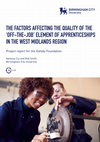
Apprenticeships have become a key feature of the education and training landscape, addressing the... more Apprenticeships have become a key feature of the education and training landscape, addressing the need for a refreshed route for young people on vocational pathways while also, potentially addressing a need for the in-work training of adults in a rapidly changing employment market. The most recent policy drive on apprenticeships, launched by the Conservative government in 2015 and underpinned by the radical new funding mechanism of the employers’ levy, with the move from frameworks to standards explicitly stated an intention to put employers
firmly ‘in the driving seat’. To be effective and successful, this model needs to complement the in-work training that apprentices receive with off-the-job training typically provided by an external college or training provider and understood to constitute 20% minimum of the apprentice’s working hours.
Drawing on data gathered from across the West Midlands gathered between September 2018 and August 2019, this report reveals a significant variability in the quality of the off-the-job training component of apprentices. It identifies that the ‘institution’ of apprenticeship – in other words the meaning of apprenticeship as sustained across a network of relationships between different players: employer, college/training provider and apprentice is of central importance. Typically, this is a localised understanding founded on a set of common professional commitments and on mutual trust.
Commissioned by UCU, the Further Education in England: Transforming lives & Communities research ... more Commissioned by UCU, the Further Education in England: Transforming lives & Communities research project aims to understand and provide robust evidence of how further education is vital in transforming lives and communities in 21st century Britain. It also provides evidence of how and why further education is an important lever for supporting social justice, sustainability and social cohesion; it presents a picture of colleges challenging intergenerational poverty and of offering people from diverse communities hope, agency and a positive orientation towards the future.
Most further education college employees see their work
as contributing to social justice. Colleg... more Most further education college employees see their work
as contributing to social justice. College mission statements
emphasise meeting the needs of their communities, local
employers and the economy with outstanding provision. But
what tensions are there between these needs? What does it
mean to meet the needs of communities? How does this overlap
with a commitment to social justice? And what does outstanding
provision with social justice at its heart look like? This report
gathers evidence from a research project funded by the Further
Education Trust for Leadership (FETL) to provide answers to
these questions.
This report presents the findings and recommendations of
an independent research project into the... more This report presents the findings and recommendations of
an independent research project into the role of leadership in
prioritising and improving the quality of teaching and learning in
further education. The project captures the views and experiences
of further education (FE) staff working at all levels, from senior
leaders to hourly paid tutors and learning support staff.
The FE sector has endured one of the most challenging and
turbulent periods in its history of late. With FE the only part of
the education budget to have experienced year-on-year cuts
since 2010, the financial position of the sector has worsened
considerably in the last decade. Combined with the instability
caused by relentless policy reform, a period of unprecedented
marketisation and high-stakes inspection and accountability
systems, it is perhaps unsurprising that these factors have led to
what Keep (2018) describes as the ‘perfect storm’ for FE, with
the future shape and direction of the sector looking uncertain. In
light of these adversities, it is all the more remarkable then that
FE continues to deliver a high level of quality in teaching and
learning in the majority of its providers. However, what is not yet
fully understood is what the relationship is between leadership
and improving teaching and learning and how leadership makes
or fails to make a difference. This research project emerged in
response to these questions, to address these gaps in knowledge
in the context of the wider FE backdrop.
Learning and work institute (publisher), 2019
Rethinking workforce development
Healthy, Wealthy and Wise: The impact of adult
learning across t... more Rethinking workforce development
Healthy, Wealthy and Wise: The impact of adult
learning across the UK identifes a range of economic
and social policy challenges confronting the four
nations today and argues that adult learning can
make an important contribution to addressing these
and promoting a fairer and more inclusive society.
Published in 2017 by Learning and Work Institute
(L&W) and its partners as part of their work for the
European Agenda for Adult Learning (EAAL), the
report draws on a wide range of evidence from
research and practice under the three broad themes
of health, work, and community. Healthy, Wealthy and
Wise calls for innovative approaches to the funding,
planning and delivery of learning, and for closer
collaboration between the adult learning sector and
other services.
This is the summative report of the Transforming Lives project. It draws on some of our other pap... more This is the summative report of the Transforming Lives project. It draws on some of our other papers and more data from the project to develop the theoretical position and a sest of conclusions and recommendations.
Further Education Trust for Leadership, 2019
This report presents the findings and recommendations of an independent research project into the... more This report presents the findings and recommendations of an independent research project into the role of leadership in prioritising and improving the quality of teaching and learning in further education. The project captures the views and experiences of further education (FE) staff working at all levels from senior leaders to hourly paid tutors and learning support staff. This project report explores the relationship between leadership and improvements in teaching and learning in FE. It examines the interface between strategic thinking in leadership, its application at an operational level and how this connects to outcomes in teaching and learning. In doing so, it also investigates how the impact and effectiveness of these activities are monitored and captured.



Uploads
Project Reports by Rob Smith
firmly ‘in the driving seat’. To be effective and successful, this model needs to complement the in-work training that apprentices receive with off-the-job training typically provided by an external college or training provider and understood to constitute 20% minimum of the apprentice’s working hours.
Drawing on data gathered from across the West Midlands gathered between September 2018 and August 2019, this report reveals a significant variability in the quality of the off-the-job training component of apprentices. It identifies that the ‘institution’ of apprenticeship – in other words the meaning of apprenticeship as sustained across a network of relationships between different players: employer, college/training provider and apprentice is of central importance. Typically, this is a localised understanding founded on a set of common professional commitments and on mutual trust.
as contributing to social justice. College mission statements
emphasise meeting the needs of their communities, local
employers and the economy with outstanding provision. But
what tensions are there between these needs? What does it
mean to meet the needs of communities? How does this overlap
with a commitment to social justice? And what does outstanding
provision with social justice at its heart look like? This report
gathers evidence from a research project funded by the Further
Education Trust for Leadership (FETL) to provide answers to
these questions.
an independent research project into the role of leadership in
prioritising and improving the quality of teaching and learning in
further education. The project captures the views and experiences
of further education (FE) staff working at all levels, from senior
leaders to hourly paid tutors and learning support staff.
The FE sector has endured one of the most challenging and
turbulent periods in its history of late. With FE the only part of
the education budget to have experienced year-on-year cuts
since 2010, the financial position of the sector has worsened
considerably in the last decade. Combined with the instability
caused by relentless policy reform, a period of unprecedented
marketisation and high-stakes inspection and accountability
systems, it is perhaps unsurprising that these factors have led to
what Keep (2018) describes as the ‘perfect storm’ for FE, with
the future shape and direction of the sector looking uncertain. In
light of these adversities, it is all the more remarkable then that
FE continues to deliver a high level of quality in teaching and
learning in the majority of its providers. However, what is not yet
fully understood is what the relationship is between leadership
and improving teaching and learning and how leadership makes
or fails to make a difference. This research project emerged in
response to these questions, to address these gaps in knowledge
in the context of the wider FE backdrop.
Healthy, Wealthy and Wise: The impact of adult
learning across the UK identifes a range of economic
and social policy challenges confronting the four
nations today and argues that adult learning can
make an important contribution to addressing these
and promoting a fairer and more inclusive society.
Published in 2017 by Learning and Work Institute
(L&W) and its partners as part of their work for the
European Agenda for Adult Learning (EAAL), the
report draws on a wide range of evidence from
research and practice under the three broad themes
of health, work, and community. Healthy, Wealthy and
Wise calls for innovative approaches to the funding,
planning and delivery of learning, and for closer
collaboration between the adult learning sector and
other services.